World action models
for the hardest movements
humans perform
Nutation Research is bringing classical mechanics rigor and coaching verifiability to human action-motion generation. We begin with elite sports, where the sensitive biomechanics are out-of-distribution for existing diffusion transformer models.
Product
Meet Yuna
Our first product, Yuna, automatically scores figure-skating performances, explains the physics behind each result, and generates a physically achievable target motion with actions to manifest it.
Most datasets only contain simple motion demonstrations. Ours contains the verified direction of improvement for the most complex biomechanics humanly possible.
If a world model can accurately predict and correct a skater landing on a 4 mm blade with 5 G’s of force, then a robot recovering its balance when it bumps into a kitchen counter is a trivial sub-problem. Sports is merely our wedge into training a foundational model for finely controllable motion generation across robotics, simulation, and graphics.
Try Yuna
An Interactive Motion Trail
Drag a box over the motion trail, or the raw physics signals, to zoom in on the on ghost frames. Click on the GOE bullets to expand them and interpret exactly why the score was earned. Click "illustrate on trail" to see Yuna's broadcasting graphics.

Research
Scaling Coaching to Training World Models
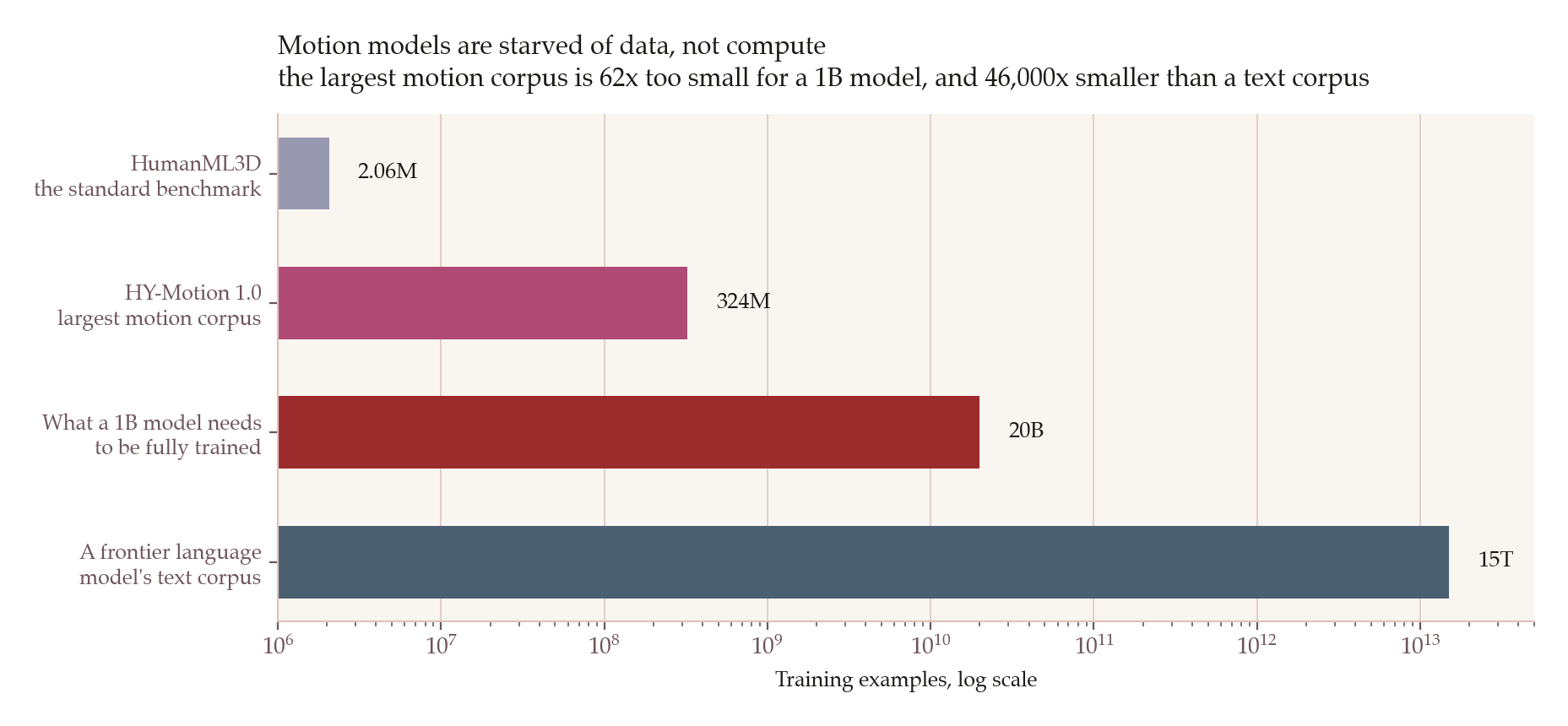
World models for robotics and graphics still struggle with complex biomechanics. Ask for rotations in the air and the body flails and angular momentum isn't conserved. Existing benchmarks don't verify physics well, and there's not enough data to fix this with scale.
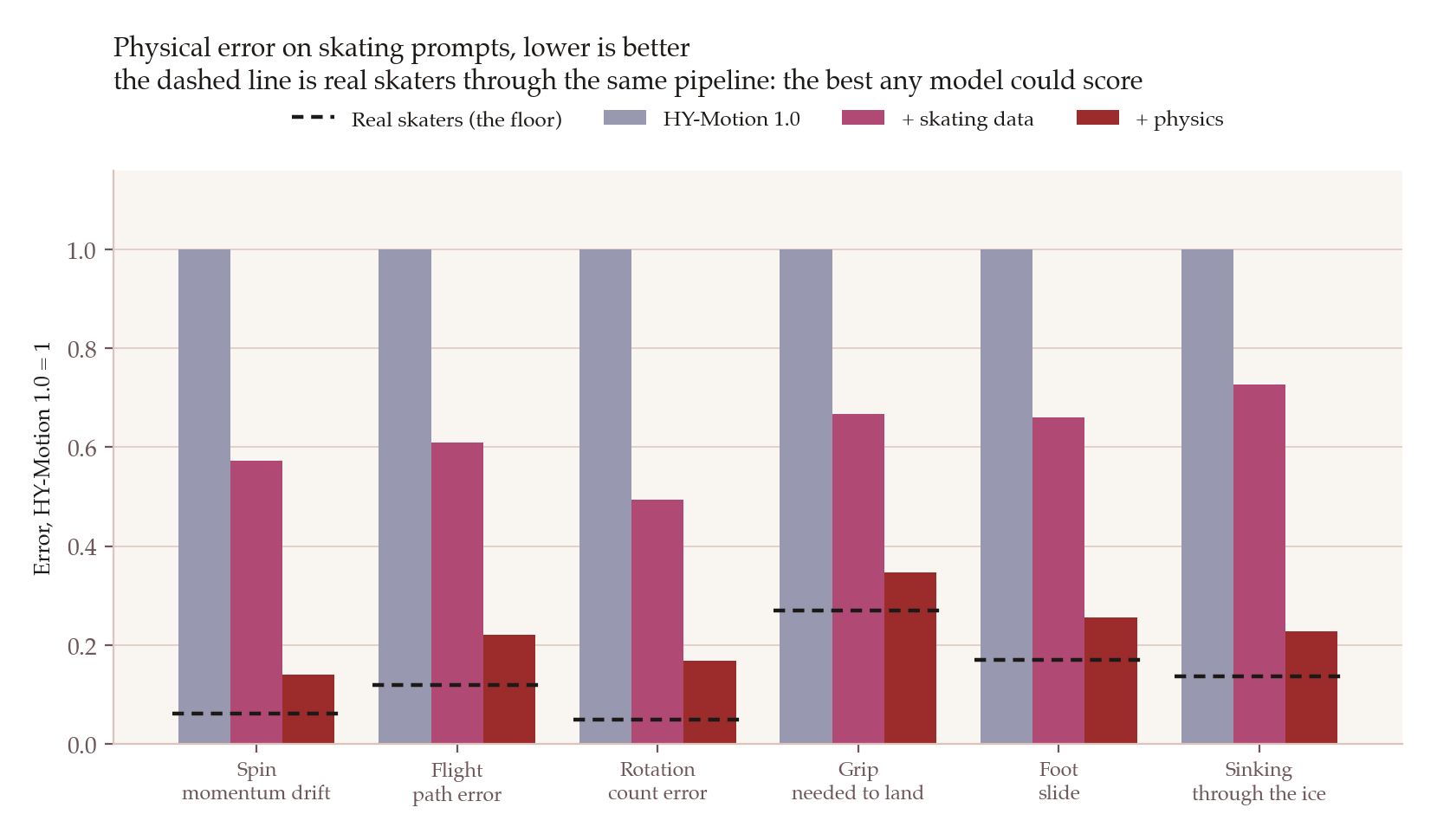
Open-weight models are already competitive, so the advantage is data not the architecture. Specifically, clearly verifiable, counterfactual data for complex biomechanical motion. Medal built a consumer product to collect gameplay data before it rejected $500M from OpenAI. We're building the same for the physical space, for the most complex biomechanical motion humans can perform to train world models with RL. Yuna is how we collect it. Our world model synthetically labels every motion a skater uploads with actional feedback to bring it to its optimum. This yields useful and inexpensive judging and coaching that athletes genuinely want to use. Part of what we did to build Yuna is extend Tencent's HY-Motion 1.0 with public skating data and physical contraints, and already saw improvements on benchmarks. With Yuna collecting private data to further refine itself, we plan to push performace well beyond the current SOTA.
Graded skating data and constraining generation to physics brings errors from HY-Motion 1.0 most of the way to the theoretical floor. The gains carry outside skating. On everyday prompts the model never trained on, like tripping on a kerb or carrying a box downstairs, the grip needed to stay upright drops from 0.61 to 0.34 and flight path error from 9.4 cm to 3.1 cm, with no change to benchmark scores. That's the key insight. Our biomechanically complex skating data improves other companys’ world models on standard robotics motion tasks.